
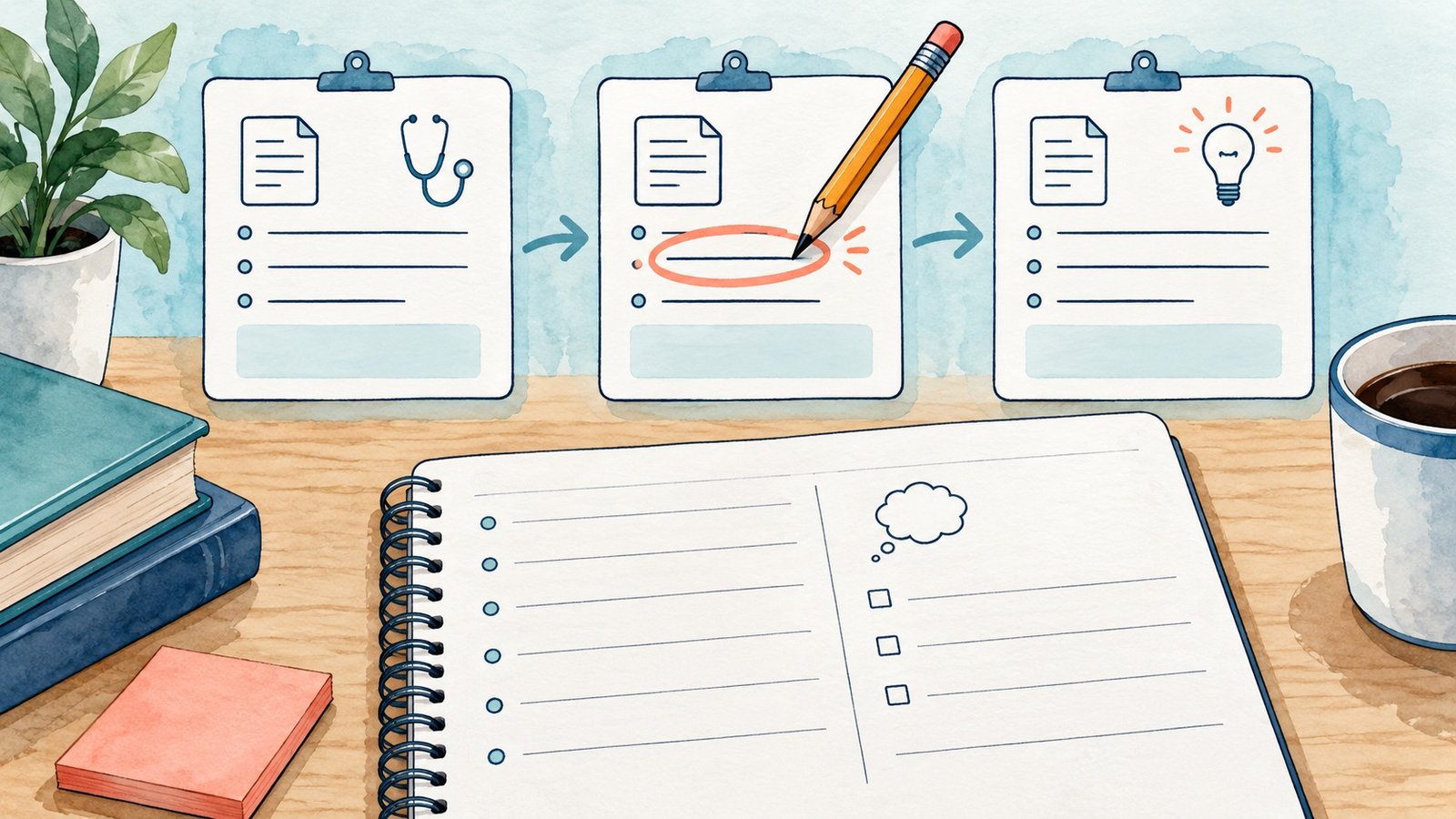

Quick answer: To review an NCLEX-style case study, build a short timeline of what the case actually says, mark what changed, explain why each change matters, compare your choice with one plausible alternative, and record what you would need to evaluate next. This is a study method, not an official NCLEX worksheet or a clinical protocol.
A case study can feel overwhelming because information arrives in pieces. If you read only the final screen, you may forget the baseline. If you focus only on a familiar diagnosis, you may miss the new detail that changes the question. This original debrief sheet helps you review the reasoning behind a practice answer, not simply whether the answer letter matched the key.
For current exam scope, use the 2026 NCLEX-RN test plan, which NCSBN says is effective April 1, 2026, through March 31, 2029. The official preparation page offers sample case studies and an exam preview. Our worksheet below is independently created by Lectures Note and does not reproduce those items or NCSBN’s model artwork.
Start with the timeline, not the answer choices
Before looking back at the rationale, draw three columns: what was known first, what became known later, and what the question asks now. Put only facts given in the case into those columns. Do not add a diagnosis, a laboratory value, or a treatment that the case never stated.
Then circle the information that changes over time. A change can be a new observation, a different response, or a new piece of context. It may be important, but the case still determines how it should be interpreted. The first useful question is, “What is different from the earlier panel?” rather than “Which memorized rule does this remind me of?”
This whole-case review differs from a single first-action question. If you need a tool for choosing among immediate priorities, use our nursing prioritization worksheet. The debrief grid here is for tracking an unfolding case from the opening information through the final evaluation.
An original case-study debrief grid
Copy this grid into a notebook or print the page. Fill it out after answering a legitimate practice case, before you read its explanation. One short sentence per box is enough.
| Prompt | Your notes |
|---|---|
| Initial picture | Which two or three facts establish the starting point? |
| New information | What changed, and when did it appear? |
| Question task | Am I being asked to identify information, interpret it, choose a response, or evaluate a result? |
| Possible explanation | What could the new information suggest? Mark uncertainty rather than inventing a diagnosis. |
| My choice and alternative | Why does my choice fit this task better than the strongest competing option? |
| What to check next | Which observation or result would help test my reasoning? |
| Source check | Which current textbook, instructor material, or official source resolves an unclear point? |
The grid is deliberately not a copy of the NCSBN Clinical Judgment Measurement Model. NCSBN describes that model as a framework for measuring clinical judgment on the exam. This page offers a separate, practical way to debrief your own learning.
A fictional example: notice the updated panel
Opening panel: A classroom simulation describes an adult preparing for routine discharge teaching. The initial information contains no newly reported concern.
Later panel: The simulation adds a new report of dizziness after standing. A subsequent panel supplies another observation, but the practice question asks the student to identify which new information deserves attention before continuing the planned teaching.
Debrief: In the “initial picture” box, write “routine teaching was planned.” In “new information,” write the newly reported dizziness and its timing. In “question task,” write “identify the relevant changed information.” The point is not to diagnose the person from one sentence or to give a treatment instruction. It is to notice that a new report must be considered in the context of the full case. The complete practice item, course guidance, and current clinical policy would determine a real response.
Now change just one part of the fictional case: suppose the last question instead asks what evidence would show that an already completed response worked. Your task changes from noticing a cue to evaluating a result. The same data can support different questions; label the task before comparing options.
How to learn from a missed answer
- Hide the rationale for a minute. Write what you thought the task was and which detail influenced your answer.
- Compare the two most plausible options. Explain why you chose one. If you cannot, identify the missing knowledge rather than memorizing an answer letter.
- Read the source explanation carefully. Check whether it relies on a fact in the case, a clinical concept you need to review, or an assumption you added.
- Record one revision. “Next time I will track the later panel” is more useful than “I need to study harder.”
- Test transfer. Try a different legitimate case later. Recognition of the same item is weaker evidence of understanding than explaining a new one.
Our med-surg body-system review method can help you file a knowledge gap by topic. For a longer preparation routine, pair the grid with the six-week NCLEX study plan. Neither replaces your nursing program’s instruction.
Want organized fundamentals notes beside your practice cases?
The paid Fundamentals of Nursing Study Notes Bundle is a separate course supplement. Check its product description and sample pages before buying; this free debrief method stands on its own.
Common questions
Is this an official NCLEX case-study worksheet?
No. This is an independent Lectures Note study organizer. For authentic item types and the current test plan, use NCSBN’s official preparation resources.
Should I copy practice questions into my notes or blog?
Respect the rights and terms of the question source. You can record your own learning point without reproducing a proprietary question, answer set, or rationale.
What if the rationale conflicts with my course material?
Check the item’s date and complete context, then ask your instructor or another qualified educator to resolve the discrepancy. Do not assume that a short online explanation overrides current course or clinical guidance.
Sources and editorial note
- NCSBN: 2026 NCLEX-RN test plan and effective dates
- NCSBN: official sample case studies and exam preview
- NCSBN: Clinical Judgment Measurement Model overview
Prepared by Lectures Note as an independent educational article. The debrief grid and fictional example are original and are not NCLEX items, NCSBN model reproductions, patient-specific advice, or a promise of exam performance. Follow current program instruction, professional supervision, and local policy.