
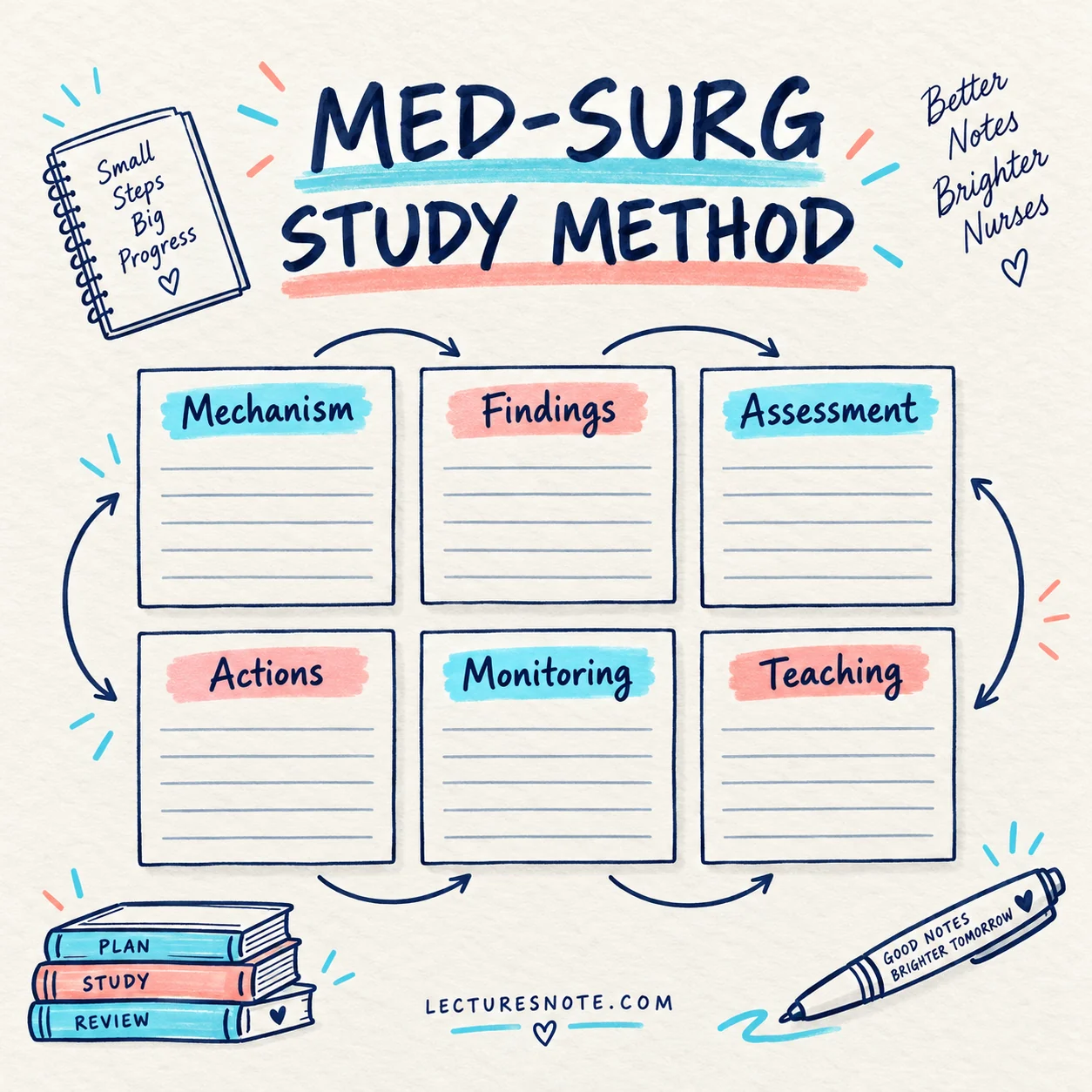

Quick answer: To study for med-surg nursing, start with one body system, connect each condition to its mechanism and assessment findings, then practice explaining the reason for each nursing action. Use a short condition sheet, compare related conditions, and test yourself before reopening your notes.
Med-surg can feel like a different course every week: cardiac conditions, respiratory problems, renal changes, endocrine disorders and more. Copying every slide into a longer document can leave you with plenty of notes but no clear starting point for review.
This guide gives you a repeatable way to turn lecture content into a focused study session. Use it alongside your syllabus, assigned reading and instructor guidance. The downloadable worksheet is an original blank organizer; it is not a clinical protocol or a completed care plan.
Download the free Med-Surg worksheet (PDF)
One page • US Letter • Printable for personal study • No signup required
1. Start with what your course expects you to do
Before opening a new chapter, read the learning objectives for the current unit. Turn each objective into a question. If the objective asks you to compare two conditions, your notes should help you compare them. If it asks you to identify a change in patient status, your review should include relevant cues and what additional information you would need.
Make a short list of the topics your instructor assigned. Mark each topic as new, partly understood or ready to explain. These labels are a planning tool, not a grade. Move a topic to the last group only when you can explain it with your notes closed.
If you are also preparing for licensure, consult the official NCLEX test plans for exam scope. Your school examination and the NCLEX serve different purposes, so a commercial study guide should not replace either your course objectives or the official exam information.
2. Build a six-field med-surg condition sheet
Use the same six questions for each condition. Consistent headings make gaps easier to spot and make later comparisons quicker. Aim for concise explanations you understand rather than paragraphs copied from a textbook.
| Field | What to write | Recall prompt |
|---|---|---|
| Mechanism | The change in normal function, in your own words. | How does the underlying change explain the findings? |
| Findings | Relevant symptoms, observations and trends, with context. | Which cues fit, and which need further investigation? |
| Assessment | The information needed to understand the situation. | What do I still need to know? |
| Actions | Course-supported nursing priorities and their reasons. | Why might this action be appropriate here? |
| Monitoring | What to reassess and how to evaluate the response. | What would indicate improvement or a new concern? |
| Teaching | Patient-education points from reliable sources. | Can I explain the main point in plain language? |
Keep a source field on every sheet. Record the textbook page, guideline or other reference and the date you checked it. Write units beside laboratory values. If two sources disagree, flag the difference and ask your instructor which applies to the coursework instead of combining them into one rule.
For example, when organizing a heart-failure unit, first write the questions your sheet must answer: What mechanism is being discussed? Which findings does the course associate with it? What would require reassessment? Fill the answers from your assigned sources, then explain the connections aloud. This is a study sequence, not a bedside treatment checklist.
3. Compare two related conditions on the same page
Once you have a basic map, place two easily confused topics side by side. Use the same row headings for both: mechanism, relevant findings, assessment, monitoring and teaching. Add a final row labeled What they can have in common. That row helps prevent a shortcut such as treating one symptom as proof of a diagnosis.
For each difference, finish the sentence: “This matters because…” If you cannot explain the connection, return to the source before adding more facts. You can start with topics already covered in your course rather than jumping ahead to unfamiliar conditions.
For a focused system-review starting point, explore our cardiac nursing study notes. Keep a distinction between a topic overview, your own condition sheet and the evidence your instructor expects you to use.
4. Use practice questions to find gaps in your reasoning
Answer a small set of legitimate practice questions matched to the material you studied. Before revealing the answer, write one sentence explaining your choice. Then read the rationale for both the correct option and the alternatives.
After a mistake, identify the kind of gap:
- Knowledge: I did not know or understand the concept.
- Cue recognition: I missed information that changed the situation.
- Task interpretation: I answered a different question from the one asked.
- Reasoning: I knew several facts but could not connect them to the choice.
Write a short correction and the source that resolved it. Revisit the concept later with a different prompt. Remembering the answer letter to a repeated question does not show that you can explain a new case.
When a rationale appears inconsistent with your current course source, treat that as a question to resolve. Older resources, transcription mistakes and missing context can all create confusion. Ask for clarification rather than memorizing an explanation you cannot reconcile.
5. Use a flexible review routine
The following 45-minute session is an example to adapt to your schedule, not a required dose of study time. Shorten or extend a section according to what you need to understand.
| Time | Task | Useful output |
|---|---|---|
| 5 minutes | Recall the previous topic without notes. | One gap to revisit. |
| 15 minutes | Build or correct a condition sheet. | One concise, sourced explanation. |
| 10 minutes | Compare a related topic. | Two differences you can explain. |
| 10 minutes | Answer questions and review reasoning. | An updated error log. |
| 5 minutes | Explain the topic and plan the next review. | A specific next step. |
Across the week, alternate new material with earlier topics. A useful review appointment has a task attached: “Explain the assessment differences” is more actionable than “Study cardiac.” For broader planning, adapt the organization ideas in our six-week NCLEX study plan to your actual course calendar.
6. Use notes, diagrams and questions for different jobs
A diagram helps you see relationships. A concise notes bundle can give you a starting structure. A blank worksheet makes you choose what matters. Practice questions reveal how you apply what you have learned. You do not have to force one resource to do all four jobs.
Before buying any bundle, look at the actual sample pages and compare its subjects with your syllabus. Check the format and what is included. A polished cover does not tell you whether the explanations are useful for the unit you are studying.
Want organized notes for your body-system review?
The Medical-Surgical Study Notes Bundle is a paid companion to this free worksheet. Open the product page, review the listed contents and view the sample before deciding whether it fits your course.
Frequently asked questions
Should I memorize every detail in my med-surg textbook?
Use your learning objectives to decide what to study first. Understand the underlying concepts, then learn the specific details your course requires. A short worksheet is a review aid, not permission to skip assigned material.
Are practice questions enough by themselves?
Questions are most useful when you examine your reasoning and resolve knowledge gaps. If you repeatedly miss the same concept, pause to review it rather than simply increasing the number of questions.
How do I use the printable worksheet?
Print one copy per condition or open it in a PDF annotation app. The PDF is a blank printable sheet, not an interactive form. Fill it using your course sources, then cover it and explain the topic from memory. Record what needs checking.
Can this method guarantee an exam pass?
No. Results depend on many factors, including preparation, course requirements and how well you understand and apply the material.
Sources and further reading
- NCSBN / NCLEX: official test plans for current exam scope.
- UNC Learning Center: Studying 101 for active study and distributed practice.
Editorial note: This is a study-organization guide from Lectures Note. It does not provide patient-specific medical advice or replace course materials, clinical supervision or local policy. Lectures Note is independent of NCSBN and NCLEX.