
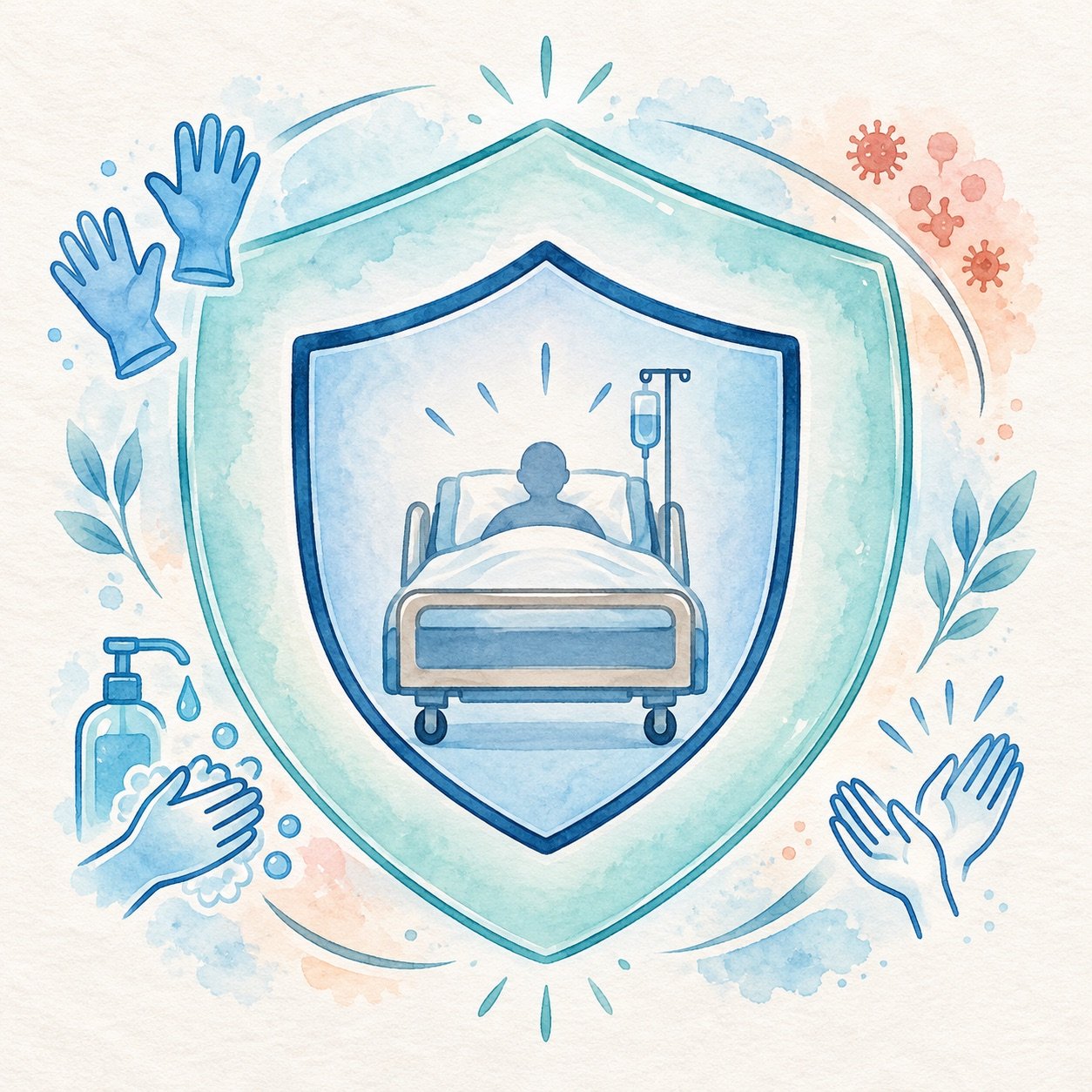

Quick answer: Standard Precautions are the baseline for every patient-care encounter. Transmission-Based Precautions are an additional tier for a patient with a known or suspected infectious agent that needs extra measures. The additional tier never replaces the baseline. In a nursing-school question, identify the baseline first, then verify whether the scenario calls for contact, droplet, airborne, or a combination under current guidance and local policy.
These two labels are easy to confuse because both appear in the same infection-control chapter. The distinction is not “routine patients versus infectious patients.” The CDC says Standard Precautions apply to all patient care, regardless of suspected or confirmed infection status. The CDC describes Transmission-Based Precautions as the second tier, added when certain infectious agents require more control.
This is a concept comparison for students, not a room-entry checklist. Isolation decisions, signs, equipment, patient placement, and PPE selection depend on the organism or syndrome, current guidance, the setting, and facility policy. If you are in clinical placement, follow the posted instructions and your supervisor rather than an old study chart.
Picture two layers, not two competing choices
Inner layer — always: Standard Precautions for every patient-care interaction, with actions chosen according to the expected exposure and task.
Outer layer — when indicated: Transmission-Based Precautions, added for certain known or suspected infections or colonization. The CDC groups this tier into Contact, Droplet, and Airborne Precautions; a situation can require more than one category.
Study sentence: “I do not choose between Standard and Transmission-Based Precautions. I start with Standard and check whether an additional tier is required.”
That sentence is more useful than memorizing a single PPE combination for every organism. It also helps you spot a common exam trap: a question can describe a patient under an added precaution and ask about a baseline practice. The baseline does not disappear.
Comparison chart for nursing students
| Study question | Standard Precautions | Transmission-Based Precautions |
|---|---|---|
| Who is it for? | All patients in all healthcare settings. | Patients with known or suspected agents for which additional control is needed. |
| What prompts the decision? | The care interaction and anticipated exposure determine the specific baseline actions. | Known or suspected transmission risk determines whether an added category is indicated. |
| How do the tiers relate? | Remains in force. | Used in addition to Standard Precautions. |
| What should a student verify? | Hand hygiene, anticipated exposure, and the relevant routine practice. | The current organism/syndrome guidance, posted room instructions, and facility policy. |
The CDC’s Standard Precautions page lists hand hygiene, risk-based personal protective equipment, respiratory hygiene, safe injection practices, and appropriate handling of equipment and environment. It does not mean “wear the same PPE for every patient.” The expected exposure and task matter. The CDC’s additional tier identifies Contact, Droplet, and Airborne categories with different setting-dependent measures.
How to reason through a practice question
Read an invented scenario: “A student is reviewing the chart of a patient whose care plan contains an additional isolation category. The question asks whether hand hygiene still matters.” The correct reasoning step is not to memorize the disease name. Ask whether Standard Precautions still apply: yes, the CDC presents the added tier as in addition to Standard Precautions.
Now change the question: “Which specific protective equipment, room type, or transport process is required?” The two-layer idea is no longer enough. You need the exact organism or syndrome, current CDC recommendations, the clinical setting, and the facility’s policy. The CDC’s condition-specific appendix is a better verification starting point than a generic social-media mnemonic. Do not infer room-entry instructions from this page alone.
Three misconceptions worth correcting
- “Standard means no infection is present.” False. Standard Precautions apply regardless of known infection status.
- “Transmission-Based replaces Standard.” False. It adds a tier when indicated.
- “One disease name always equals one unchanged rule.” Too simple. A current source and local protocol are needed; recommendations can vary with the agent, setting, and emerging guidance.
When reviewing your own course notes, mark the date and source beside any detailed organism-to-precaution table. A bare table copied years ago can make a learner confident for the wrong reason. For broader infection-control context, the CDC Infection Control Basics overview names the two tiers explicitly.
Use this source-check practice strip
Scenario in my own words: __________
Baseline actions relevant to the task: __________
Is an added tier indicated in the scenario? Known / suspected / not enough information
Category or categories in the current source: __________
Source URL and date checked: __________
Local policy or instructor question still unresolved: __________
Try the strip with an instructor-provided case, not an identifiable patient’s chart. If the case does not give enough information, write “not enough information” and identify what would need verification. In actual care, ask the responsible clinician or infection-prevention team rather than deciding isolation from a study aid.
For related course organization, see our Fundamentals of Nursing Study Notes guide. Our nursing-process versus clinical-judgment comparison can help you separate a framework from the reasoning needed in a changing case. Our NCLEX question error log is useful if you repeatedly confuse the two tiers.
Need a broader fundamentals study reference?
The paid Fundamentals of Nursing Study Notes Bundle can support course review; check its sample and included topics before purchase. Current CDC guidance and your facility policy remain the authorities for clinical infection-control decisions.
Frequently asked questions
Are Standard Precautions only for patients without isolation signs?
No. They are the baseline for all patient care, including care of patients who also need an added isolation tier.
Do Contact, Droplet, and Airborne categories replace one another?
They describe different additional approaches, and a situation may call for more than one. Confirm the exact requirement with current CDC and local instructions.
Can I use this chart to choose PPE at the bedside?
No. It is a study model, not an operational PPE or isolation protocol. Use your institution’s current procedures and supervision.
Sources and editorial note
- CDC: Standard Precautions for All Patient Care
- CDC: Transmission-Based Precautions
- CDC: Type and Duration of Precautions by Condition
Prepared by Lectures Note as an independent educational comparison. The two-layer organizer and practice strip are original. No clinical-reviewer credential is claimed. Last source check: October 10, 2026. This page is not clinical advice.