
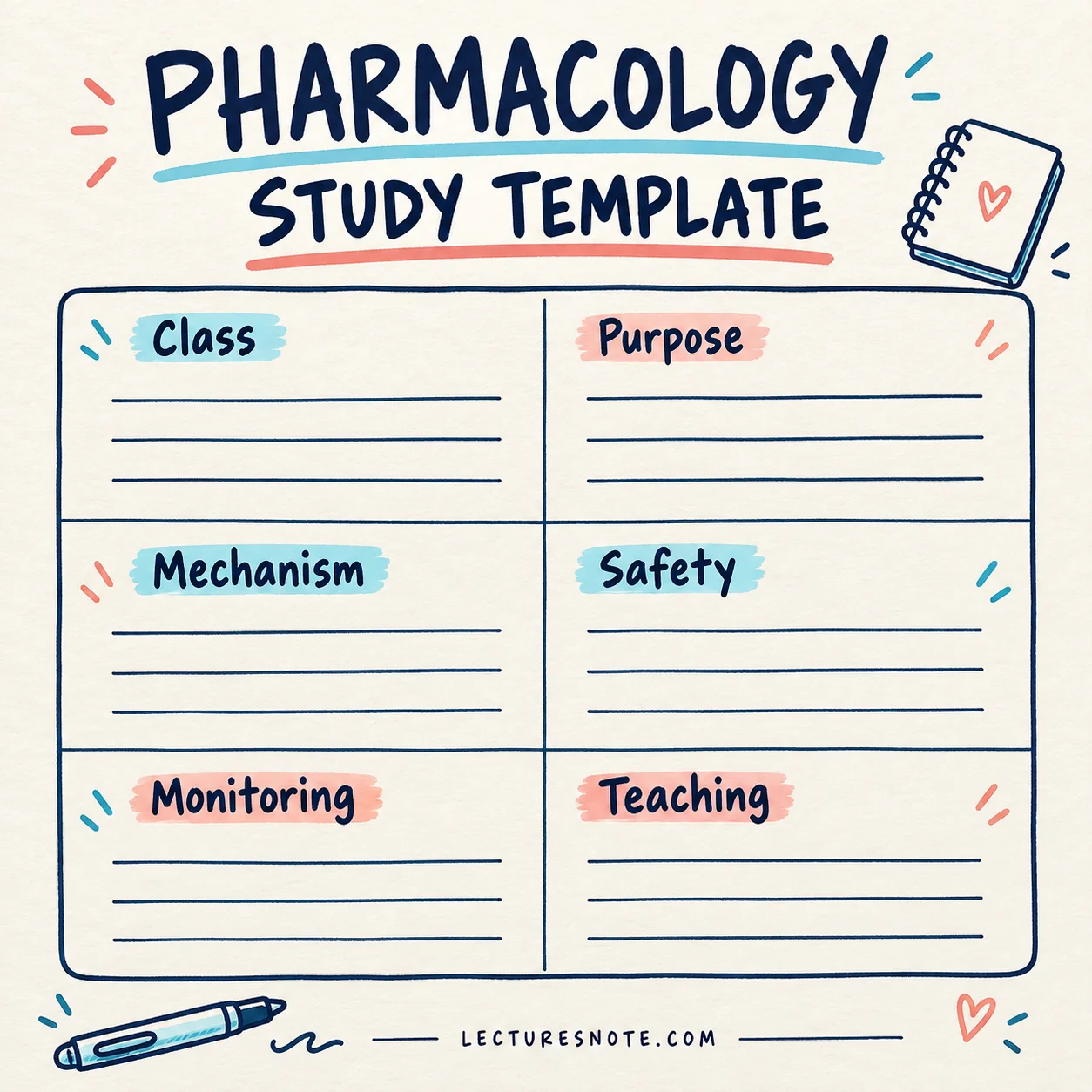

Quick answer: A useful pharmacology study template connects a medication’s purpose and mechanism with its safety considerations, monitoring and patient teaching. Start with the generic name, class, formulation and source, then summarize each section in your own words.
If every medication card becomes a page of copied text, it can be difficult to tell what you actually understand. The goal is to create a sheet you can explain and check: what the medication is intended to do, what makes its use safer, and what information is specific to the drug you are studying.
This guide includes a free, original blank worksheet for nursing coursework. It is a printable study organizer, not a prescription, medication order or medication-administration record.
Download the free pharmacology template (PDF)
One page • US Letter • Printable for personal study • No signup required
What belongs in a pharmacology study template?
Start with the exact generic name and the formulation or route being studied. The same name can appear in different product forms. Add the drug class, the source and the date checked before completing the rest of the sheet.
| Section | What to record | Question to ask yourself |
|---|---|---|
| Purpose and mechanism | Verified uses and a plain-language explanation of how it works. | How does the mechanism connect to the intended effect? |
| Expected response | The response your course source describes as beneficial. | How would effectiveness be evaluated? |
| Safety and interactions | Relevant warnings, contraindications, adverse effects and interactions. | What information changes the safety picture? |
| Assessment and monitoring | What is checked, when, and why, from the appropriate source. | Can I explain the reason for each check? |
| Patient teaching | Instructions and key information from verified patient guidance. | Can I explain this clearly without jargon? |
| Drug-specific details | Exceptions, formulation details and points requiring verification. | What must not be assumed from the class alone? |
The worksheet deliberately leaves room for your source notes. A blank section should make you curious, not tempt you to invent an answer. Write “verify” when a detail is unclear and resolve it before treating the card as a reliable review resource.
How to fill out the pharmacology study card
1. Choose one medication from the current course unit
Begin with a medication assigned by your instructor. Read the relevant course material, identify the generic name and confirm the product form. Avoid starting with a large list of unfamiliar drugs: first learn how to build one useful card.
2. Write the purpose and mechanism in your own words
Keep these two ideas separate. The purpose describes what the medication is used for; the mechanism explains its action. A sentence that simply repeats the drug class is not yet an explanation. If the mechanism depends on anatomy or physiology you cannot explain, review that connection first.
3. Connect each safety point with a reason
Separate expected therapeutic effects from adverse effects and warnings. Then ask what the information implies for the study scenario: what would need checking, what would require clarification, and which teaching point belongs with it? Do not turn a class-level mnemonic into a universal instruction to give, hold or change a medication.
4. Make the monitoring section specific
“Monitor the patient” gives you little to recall. Your source may discuss a particular assessment, laboratory test, response or follow-up. Record the specific point and the reason for it. If you add a number, include its unit, source and context. Patient-specific orders and clinical policies cannot be replaced by this worksheet.
5. Explain the teaching point aloud
Try a short plain-language explanation using verified guidance. Check whether you included the information the patient would need to understand the instructions. If a fact is unclear, return to the medication guide or ask your instructor rather than filling the space with a guessed rule.
6. End with an unresolved-question box
One good question is a useful output from a study session. It might concern a formulation difference, a warning you do not understand, or a conflict between sources. Record exactly what needs resolving so your next session has a clear starting point.
Use drug classes as a structure, then check individual differences
A class overview can help organize a large syllabus, but each medication still needs its own checked details. Use a comparison sheet to record shared concepts, then keep exceptions visible on individual cards. Name endings may help recall some groups; verify the classification instead of treating a suffix as proof.
Douglas College’s pharmacology study tips recommend organizing medications by class and using study sheets and comparison tables. The template here is an original organizer for applying that kind of structured review to your own coursework.
For a comparison activity, choose two medications your course discusses together. Ask: Are their purposes the same? What differs in the product information? Which assessment or teaching points are drug-specific? Put a source beside every difference you record.
Turn the template into an active-recall exercise
Once you have completed and checked a card, cover the answers and use these prompts:
- State the generic name, class and formulation.
- Explain the intended effect and mechanism.
- Name a source-verified safety concern and explain why it matters.
- Explain one monitoring point rather than only naming it.
- Give a plain-language teaching point.
- Identify a detail you must verify for this specific medication.
Reopen the card, correct your explanation and record the gap. Return to it in a later study session with a different prompt. When you use practice questions, explain your choice before reading the rationale; after checking, update the concept you missed rather than memorizing an answer letter.
An example 20-minute review could include five minutes recalling a previous card, ten minutes checking one new medication, and five minutes explaining a comparison. Adjust the time to your workload and understanding. There is no single schedule that guarantees a particular examination result.
Choose medication sources you can check
Begin with your assigned course materials and instructor-approved drug reference. For US product labeling, the National Library of Medicine’s DailyMed database provides labeling submitted to the FDA that is currently in use. It does not include every FDA-regulated product, and a database listing alone is not a claim of FDA approval.
Check that the label matches the medication and formulation you are studying. Record its identity and revision information where available. For patient-facing explanations, MedlinePlus drug information can be a useful companion. Resolve conflicts with your instructor or appropriate clinical reference rather than combining incompatible instructions.
A drug card helps organize learning. It does not establish a patient-specific dose, decide whether a medication should be administered, or replace the checks required in clinical practice.
Connect your medication review to the rest of nursing school
When you encounter the medication in a body-system unit, link your card to the condition sheet. Explain the connection among the condition, intended effect, safety information and reassessment. Our fundamentals of nursing study notes can help you organize broader nursing-process review, while the six-week NCLEX study plan offers a framework for scheduling review.
Compare the template with organized pharmacology notes
Use the free worksheet to build your own cards. If you also want prepared study notes, review the Pharmacology Nursing Study Notes Bundle’s contents and sample pages to see whether its format matches your coursework.
Frequently asked questions
Is the pharmacology template free?
Yes. The blank one-page worksheet linked in this article is free to download and print for personal study. The separate pharmacology notes bundle is a paid product.
Can I type into the PDF?
It is a printable PDF, not an interactive form. You can print it or add text with a PDF annotation app that supports that feature.
Should I put a dosage on every drug card?
Follow your assignment requirements. If dosage information is required, verify the exact indication, formulation, population, units and source. Do not use a study card as a patient-specific prescribing or administration instruction.
Should I make one sheet per class or per medication?
Use a class overview to compare concepts and an individual sheet for the specific medication. The downloadable template is designed for one medication at a time so differences remain visible.
Sources and further reading
- Douglas College Learning Centre: Pharmacology Study Tips.
- National Library of Medicine: DailyMed.
- MedlinePlus: Drugs, Herbs and Supplements.
Editorial note: This is an educational organization guide from Lectures Note, not a clinically reviewed medication reference. Verify medical facts using current sources and follow your program’s requirements and clinical supervision.